Following UNESCO Intangible Cultural Heritage inscription in December 2024 and the historic simultaneous designation of GI Kyoto, GI Tottori, and GI Fukuoka on October 1, 2025, Japan now protects 23 regional sake GIs. Explore the complete GI map and Japan’s 5 greatest sake brewery auberges.
Post-UNESCO Momentum & Japan’s Complete 23-Region Sake GI Map
In December 2024, UNESCO officially inscribed Japan’s "Traditional knowledge and skills of sake-making with koji mold" onto the Representative List of the Intangible Cultural Heritage of Humanity (documented on the National Tax Agency UNESCO Special Portal). That milestone permanently reframed how international wine directors approach Japanese sake—shifting attention from isolated rice-polishing numbers toward holistic terroir provenance, directly paralleling France’s AOC and Italy’s DOCG frameworks.
Anchoring this provenance system is Japan’s statutory Geographical Indication (GI) protection administered by the Commissioner of the National Tax Agency (full official registry at the NTA Geographical Indications Official List). Beginning with local pioneer GI Hakusan (2005) and Japan’s first prefectural appellation GI Yamagata (designated 2016, celebrating its 10th anniversary in 2026), regional sake GIs expanded dynamically with GI Aomori in June 2025, followed on October 1, 2025 ("World Sake Day") by the historic first-ever simultaneous designation of three regions—GI Kyoto, GI Tottori, and GI Fukuoka. Japan now protects 23 regional sake GIs (24 including national GI Nihonshu, and 34 total beverage GIs across sake, shochu/awamori, and Japanese wine):
Beyond Napa & Bordeaux: Comparing Japan’s 5 Ultimate Sake Brewery Auberges
Alongside the expansion of protected GI regions, Japan’s luxury hospitality landscape has birthed an extraordinary travel genre: the Sake Brewery Auberge. Discerning collectors and sommeliers now book months ahead to sleep beside—or directly inside—historic wooden kura, dining on regional cuisine cooked with the very spring water fermenting in the tanks next door.
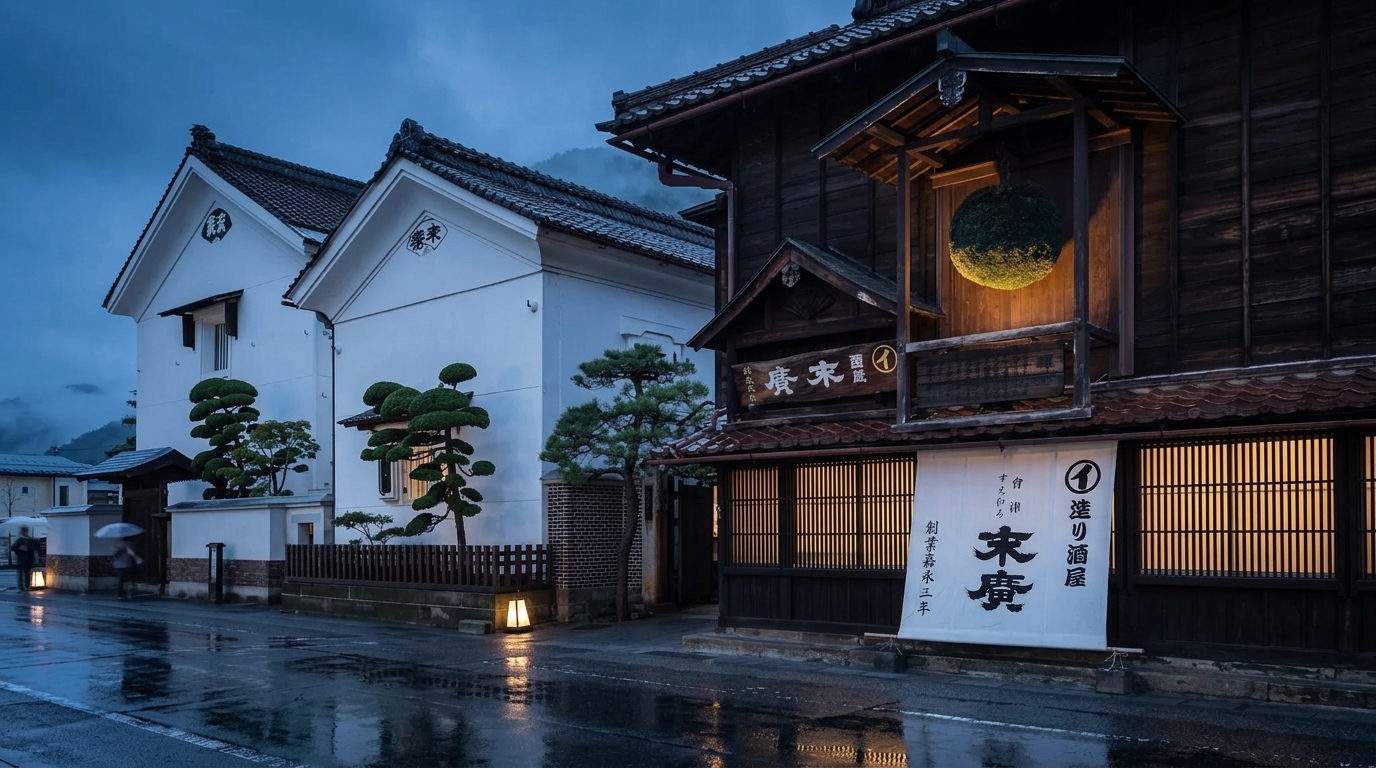
| Destination & Sanctuary | Location (Protected GI) | Brewery & Flagship Sake | Architectural & Experiential Concept | Stay Benchmark & Flagship 720ml Price |
|---|---|---|---|---|
| Oyado Fukuchiyo | Kashima, Saga (GI Saga) | Fukuchiyo Shuzo (Nabeshima) | Restored 100-year thatched merchant home; 1 group per night | ~¥110k–¥160k/person w/ pairing dinner (Nabeshima ¥2,200–¥11,000) |
| ESHIKOTO / Kanshukuen | Eiheiji, Fukui (Kuzuryu Gorge) | Kokuryu Shuzo (Kokuryu / Ishidaya) | 70,000m² riverside estate w/ private hot-spring villas | ~¥90k–¥150k/person half-board (ESHIKOTO AWA ¥6,050–¥33,000) |
| BYAKU Narai | Narai-juku, Nagano (GI Nagano) | suginomori brewery (narai) | Decentralized heritage hotel inside a 200-year Edo post town | ~¥55k–¥90k/person half-board (narai 720ml ¥3,850–¥6,600) |
| SHIRAIWA (IWA 5) | Tateyama, Toyama (GI Toyama) | Shiraiwa K.K. (IWA 5) | Ex-Dom Pérignon Chef de Cave × Kengo Kuma wooden kura | By-appointment VIP visit (IWA 5 720ml ~¥15,950 / $190–$250 overseas) |
| KURABITO STAY | Saku, Nagano (GI Nagano) | Kitsukura Shuzo (Kikuhide, est. 1696) | Sleep in authentic brewer quarters & make koji/mash over 3 days | 3D2N immersion ~¥95k–¥130k/person (Kikuhide ¥1,980–¥4,400) |
Inside the 5 Essential Sake Brewery Auberges & Sanctuaries
Saga’s Oyado Fukuchiyo — One-Group-Per-Night Privacy with Nabeshima
After Nabeshima Daiginjo won Champion Sake at the 2011 IWC and put Kashima City (pop. 30,000) on the global map, brewer Naoki Iimori set out to preserve the surrounding Edo-period post town of Hizen-Hamashuku. The result is Oyado Fukuchiyo Official Site, one of Asia’s most coveted culinary hideaways.
Fukui’s ESHIKOTO & Kanshukuen ESHIKOTO — Kokuryu’s Forest Sanctuary
Perched above the emerald Kuzuryu River minutes from Zen Buddhism’s head temple Eiheiji, eighth-generation Kokuryu head Naoto Mizuno created ESHIKOTO Official Site—a breathtaking architectural dialogue between fermentation, craft, and nature.
Nagano’s BYAKU Narai × suginomori brewery — High-Altitude Edo Post Town
Along the historic Nakasendo trail in Narai-juku (940 meters elevation), BYAKU Narai Official Site sensitively transformed a dormant 1793 brewery (Suginomori Shuzo) and neighboring Edo merchant townhouses into a decentralized boutique hotel.
Toyama’s SHIRAIWA (IWA 5) & ⑤ Nagano’s KURABITO STAY
Rounding out the top five are two destinations representing architectural couture and hands-on UNESCO craftsmanship:
Practical Booking Windows & Hokuriku Golden-Route Itinerary Tips
To experience brewery tourism at its peak, align travel with either winter kanzukuri brewing (November through March) or year-round micro-breweries like BYAKU Narai. Because Oyado Fukuchiyo and Kanshukuen ESHIKOTO host only one to eight parties per night, reserve 3 to 6 months ahead. Riding the extended Hokuriku Shinkansen from Tokyo through GI Nagano, GI Toyama (IWA 5), Fukui (ESHIKOTO), and down into newly designated GI Kyoto now forms the ultimate four-day sake terroir traverse.
Featured Breweries, Specs & Flavor Balance
| Flagship Label | Brewery & Region | Signature Rice & Water | Brewery Profile |
|---|---|---|---|
| Chiyo | Chiyo Sake Brewery Co., Ltd. (621 Kujira, Gose-shi, Nara 639-2312, Japan) | Yamadanishiki, Omachi, Aiyama, Isenishiki, Kamenoo, Akitsuho · Deep subsurface water from the Mt. Katsuragi range (soft to medium-soft water) | Brewery Profile |
| ESHIKOTO | Kokuryu Sake Brewing Corporation (1-38 Matsuoka-Kasuga, Eiheiji-cho, Yoshida-gun, Fukui 910-1133, Japan) | Hyogo Tojo Yamada Nishiki, Fukui Sakahomare, Gohyakumangoku, Koshinoshizuku · Mt. Hakusan Range & Kuzuryu River Subterranean Soft Water | Brewery Profile |
| Hizen Hamashuku | Minematsu Shuzojo (Otsu 2761-2 Hamamachi, Kashima-shi, Saga 849-1322, Japan) | Yamada Nishiki, Saganohana, Reiho, and Sagabiyori · Pure subterranean soft water from the Mt. Tara mountain range | Brewery Profile |
| Ginrei Tateyama | Tateyama Brewing Co., Ltd. (217 Nakano, Tonami-shi, Toyama 939-1322, Japan) | Hyogo Yokawa Special-A Yamada Nishiki, Gohyakumangoku, Dewasansan, Oyamanishiki · Sho River System Subterranean Soft Water | Brewery Profile |
| Nabeshima | Fukuchiyo Shuzo (1244-1 Hamamachi, Kashima-shi, Saga 849-1322, Japan) | Yamada Nishiki, Omachi, Aiyama, Gohyakumangoku, Saganohana, and Kitashizuku · Pure subterranean soft-to-medium-soft water from the Mt. Tara mountain range | Brewery Profile |
| Itteki Senzan | Nishioka Kawamura Sake Brewery (1-1 Koshikidani-cho, Fukui-shi, Fukui 910-3613, Japan) | Fukui Gohyakumangoku, Yamada Nishiki · Western Echizen Mountain & Koshikidani Spring Soft Water | Brewery Profile |
| narai | Suginomori Brewery Inc. (551-1 Narai, Shiojiri-shi, Nagano 399-6303, Japan) | Azumino Nagano-grown Sankei Nishiki, Kinmon Nishiki, and Miyama Nishiki · Narai-juku Sacred Cedar Forest Natural Mountain Spring Water (Ultra-Soft Water, Hardness ~25) | Brewery Profile |
| Kikuhide | Kitsukura Sake Brewery Co., Ltd. (653-2 Usuda, Saku City, Nagano 384-0301, Japan) | Saku-Grown Hitogokochi, Miyama Nishiki, Kinmon Nishiki, and Sankei Nishiki · Yatsugatake Range & Chikuma River Subterranean Well Water (Medium-Hard Water) | Brewery Profile |
| Mirai | Uehara Shuzo Co., Ltd. (1524 Ota, Shin-Asahi-cho, Takashima-shi, Shiga 520-1502, Japan) | Wataribune No. 2, Tamasakae, Ginfubuki, Yamadanishiki, Omachi, Kamenoo · Hira Mountain Range Artesian Subterranean Soft Water (Harie Spring Vein) | Brewery Profile |
| Sansui | Oimatsu Shuzo (2912 Otsuru-machi, Hita-shi, Oita 877-1107, Japan) | Yamada Nishiki, Gohyakumangoku, and local Hita sake rice · Clear subterranean soft water from the Mt. Hiko and Ohi River system | Brewery Profile |
The founding local brand enjoyed in Gose since 1873, offering a calm, approachable profile.
The estate luxury line from Kokuryu's ESHIKOTO cultural complex, featuring traditional-method sparkling sake ESHIKOTO AWA and cellar-exclusive bottlings.
Brewed since 1916 at the entrance to Hizen Hamashuku's historic white-walled Sake Brewery Street in Kashima City, Saga Prefecture, by Minematsu Shuzojo using pure soft subterranean water from the Mount Taradake range and local Saga Yamada Nishiki, Saga no Hana, and Sagabiyori rice. Named directly after this nationally preserved Edo-period post town, Hizen Hamashuku offers a rounded, velvety soft-water entry, generous Saga rice sweetness and umami, and a calm, food-friendly finish. It pairs wonderfully with Ariake Sea Takezaki crab, broiled mudskipper, Saga beef, and local sesame tofu.
Founded in 1830 in the Tonami Plain of Toyama, Tateyama Shuzo is the flagship name of Toyama brewing, crafting crystal-clean sake from soft Shogawa River snowmelt water and highly polished Grand Cru Yokawa Yamada Nishiki, Gohyakumangoku, and Oyama Nishiki rice. Driven by an uncompromising 'Quality First' ethos across every tier—from everyday Karakuchi to 'Amaharashi' Junmai Daiginjo and unfiltered Aiyama Daiginjo—Ginrei Tateyama offers pristine delicacy, subtle savory breadth, and a brisk mountain-air finish. Pair it with Toyama Bay white shrimp (shiro-ebi) sashimi, firefly squid (hotaru-ika), or winter yellowtail (kan-buri) shabu-shabu.
Created in 1998 by master brewer Naoki Iimori in the historic post town of Hizen-Hamashuku, Saga, and crowned 2011 IWC Champion Sake, Nabeshima stands among the pinnacle of Japanese sake. Woven from pure Mt. Tara subterranean water and elite Yamada Nishiki, Aiyama, and Omachi rice, its lush orchard aromatics, satiny sweetness, and pinpoint effervescence pair sublimely with Saga Wagyu and fine kaiseki.
Handcrafted in Koshikidani, Fukui by 1869-founded Nishioka Kawamura Sake Brewery, 'Ishida' pairs soft mountain spring water with Fukui-grown Gohyakumangoku and Yamada Nishiki for honest grain depth and a brisk finish.
Originally founded in 1793 in the preserved Nakasendo post town of Narai-juku (elevation 940m) in Shiojiri, Nagano Prefecture, historic Suginomori Brewery was reborn in 2021 as a luxury microbrewery crafting its flagship narai. Brewed by Toji Genki Irie using ultra-soft Kiso mountain spring water (hardness ~25) and Azumino-grown Sankeinishiki, Kinmon Nishiki, and Miyama Nishiki rice, it sparkles with pineapple-like juiciness, pinpoint spritz, and alpine purity.
Founded in 1696 along the upper Chikuma River in Usuda, Saku City, Nagano Prefecture, Kikuhide is the flagship of Kikkura Shuzo—guided for 19 generations by the Ide family's motto, 'Sake is an honest food.' Brewed with clear medium-hard subterranean water from the Yatsugatake and Chikuma River basin and Saku-grown Hitogokochi, Miyama Nishiki, Kinmon Nishiki, and Sankei Nishiki rice, its lineup—from classic Junmai Daiginjo to the unpasteurized 'Mujinzo' series—pairs effortlessly with simmered Saku carp, Shinshu salmon, and salt-grilled river trout.
A special-edition junmai sake brewed with pesticide-free organic rice and indigenous yeast, embodying a sustainable vision for the future of sake brewing.
Founded in 1789 in the Otsuru valley of Hita City, Oita Prefecture—the historic 'Water Capital' and former Edo shogunate territory—Sansui ('Mountains and Waters') is the flagship sake of Oimatsu Shuzo. Brewed with pristine soft subterranean water from the Ohi River fed by sacred Mount Hiko alongside Yamada Nishiki, Gohyakumangoku, and local Hita rice, it captures the crystal-clear mountain-and-river landscape of Hita with a smooth, composed palate that pairs wonderfully with salt-grilled Mikuma River ayu sweetfish, crispy Hita yakisoba, and seared Bungo wagyu.
Recommended Pairing
Weekly Sake & Tasting Dispatch
Curated seasonal releases, sub-zero arrivals, and tasting city guides across global editions.