From bottle refermentation to carbonation. The diverse world of effervescent sake.
The Rapid Rise of Sparkling Sake
In the 2020s, sparkling sake has become the fastest-growing category in the sake market. While overall shipments of sake have plateaued, the effervescent segment keeps climbing year after year, driven by drinkers in their twenties and thirties, sake beginners, and the Korean market — the world's third-largest destination for sake exports by volume, where opening a meal with a sparkling sake toast is now a familiar sight in Seoul's restaurant scene. The appeal is easy to explain: low alcohol (5-12%), a graceful balance of sweetness and acidity, and the visual festivity of bubbles rising in the glass. The gateway role that Champagne has long played for wine culture is now being performed, within sake culture, by sparkling sake. The lineage's pioneer was "Suzune," the low-alcohol sparkling sake that Miyagi's Ichinokura introduced in 1998 — at around 5% alcohol, a design that defied the common sense of its day and is now, a quarter century on, re-evaluated as the origin point of the entire category.
Quick Specs & 2026 Rating Summary
Three Production Methods — How the Bubbles Are Born Decides Everything
The character of a sparkling sake is determined by how its carbon dioxide is created and how it dissolves into the liquid. Three methods dominate, each with its own philosophy.
Bottle Refermentation — The same painstaking method as Champagne. Finished sake receives an addition of yeast and sugar, is sealed in the bottle, and undergoes secondary fermentation there. With nowhere to escape, the CO2 dissolves into the sake, producing fine, persistent bubbles and complex, yeast-driven flavors. Nanbu Bijin's "Awa Sake Sparkling" won the IWC's top sparkling prize, and in 2026 two landmark international victories proved the method's global stature: at the 10th anniversary Kura Master 2026 in Paris, Yamanashi Meijo's "Shichiken Sparkling Hoshi no Kagayaki" became the first sparkling sake in history to capture the competition's overall supreme President Prize, while at the International Wine Challenge (IWC) 2026 in London, Kato Kichibee Shoten's "Born Premium Sparkling" won the Sparkling Trophy.
Providing the institutional backbone for this ascent is the Japan Awasake Association ([Awasake Official](https://awasake.or.jp/)), which celebrated its 10th anniversary on October 20, 2026, having grown from 9 founding houses to 34 member breweries nationwide. Certified Awasake must satisfy rigorous Champagne-grade criteria: pure rice-and-koji brewing from graded domestic rice (Grade 3 or higher) with no additives, natural carbonation solely from secondary fermentation in bottle or tank (artificial CO2 injection prohibited), crystal-clear visual brilliance achieved through disgorgement/clarification, and gas pressure of at least 3.5 bar at 20°C (pasteurized, minimum 11% ABV). Many breweries still perform riddling (remuage) and disgorgement entirely by hand — behind a single glass of bubbles hides staggering labor.
Active Nigori — A distinctly Japanese approach: coarsely filtered moromi is bottled while the yeast is still alive, so fermentation continues inside the bottle. The result combines vigorous effervescence — enough to erupt on opening — with fresh acidity and direct rice umami. Senkin's "Kabutomushi" and Aramasa's "Amagaeru" are the prime examples; "Amagaeru" in particular, designed at around 10% alcohol, embodies the technical mastery of SS-tier Aramasa. Always chill thoroughly and open over several minutes, loosening the cap in stages to release gas. That opening ritual is part of the pleasure.
Carbonation Injection — CO2 artificially injected into clear sake. Stable, consistent effervescence suited to mass production. Dassai Sparkling and Shochikubai Shirakabegura's "Mio" use this method, and their greatest strength is accessibility — you can find them at a convenience store. The low-alcohol sweet market that "Mio" pioneered broadened the category's base at a stroke and became a bridge toward premium bottle-refermented styles.
The Science of Temperature, Glassware, and Opening
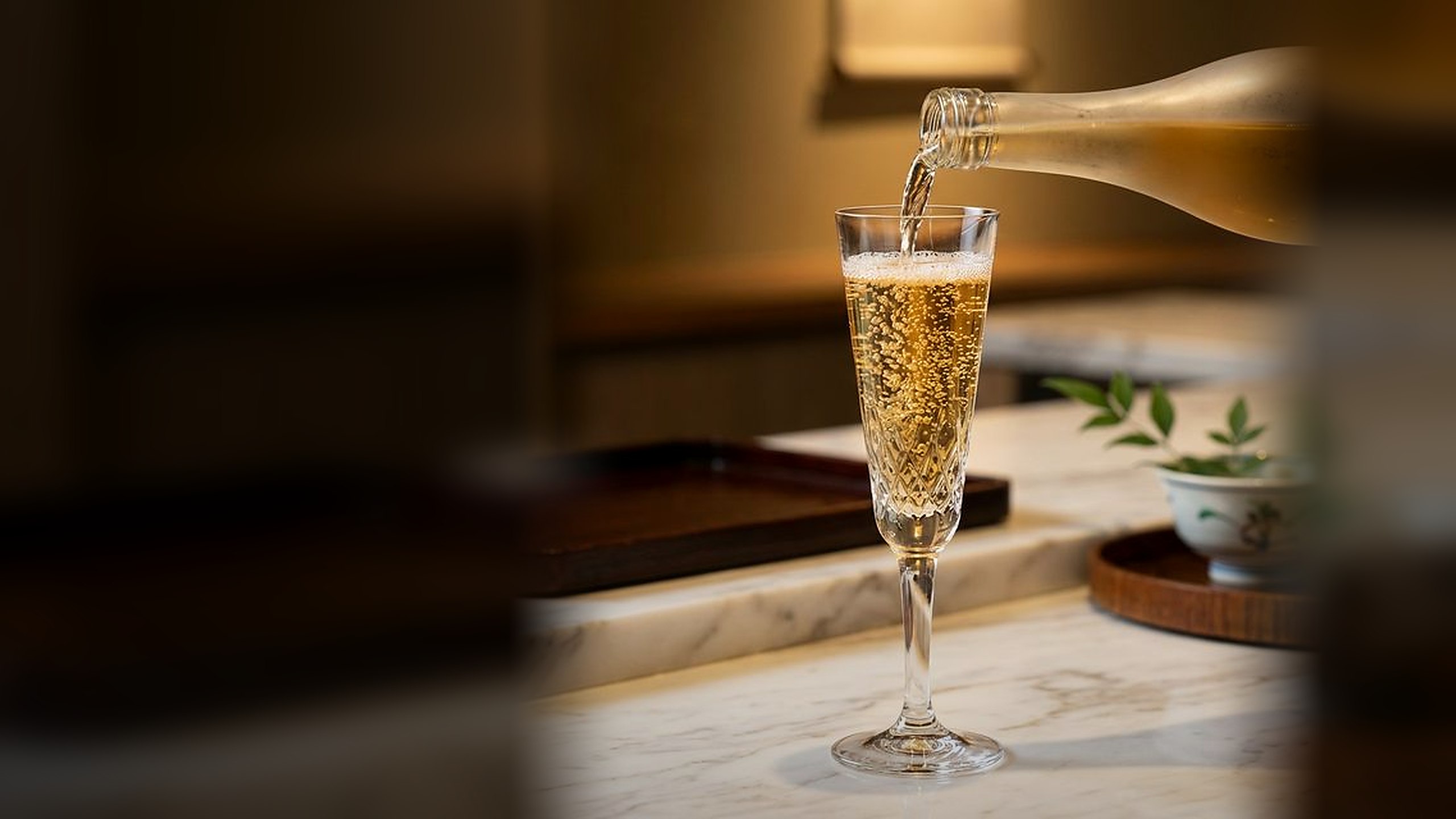
Serve well-chilled at 5-8°C. CO2 stays dissolved more readily at low temperatures, so chilling tightens the bead of the bubbles and sharpens the outline of the sweetness. A flute is the classic choice — its slender shape showcases the rising bubbles and concentrates the aroma — while premium bottle-refermented cuvees open up further in a white-wine glass.
The surprise pairing with a devoted following: Korean fried chicken. The bubbles and gentle sweetness refresh the palate against the oil and heat of spicy yangnyeom chicken, calling up appetite for the next bite. The physical scrubbing effect of carbonation plus the low alcohol's easy drinkability give this combination a clear scientific logic. Classic Japanese pairings deserve mention too: the bubbles cut through tempura's oil, while delicate sweetness flatters white-fish sashimi. Fresh cheese and fruit open the door to brunch and dessert settings.
Method × Bottle: The Practical Comparison Chart
With sparkling sake, the experience depends entirely on how the bubbles were born. Check this chart before you buy.
| Method | Example Bottles | Ref. Price | Bubble Quality & Best Temp |
|---|---|---|---|
| Bottle-fermented (clear / Awasake) | Shichiken Hoshi no Kagayaki, Born Premium Sparkling, Mizubasho Pure | approx. ¥3,800-11,000 (720ml class) | 3.5+ bar Champagne-like persistent bead. 5-7C |
| Bottle-fermented (cloudy) | Dassai Junmai Daiginjo Sparkling 45 | approx. ¥2,400 (720ml) | Sweet lees meeting vivid bubbles. 5-7C |
| Active nigori (nama) | Senkin Yukidaruma, Aramasa Amagaeru | approx. ¥1,700-3,000 | Coarse, living fizz; opening takes technique. 5-8C |
| Carbonated | Sho Chiku Bai Shirakabegura Mio | approx. ¥700 (300ml) | Light, sweet, beginner-friendly; party pour. 5C |
For the Toast
Clear bottle-fermented is the only answer. Poured into a flute, the rising bead stands comparison with Champagne — the perfect opening to a Japanese banquet.
With the Meal
Cloudy sparkling. The lees' sweetness flatters fried food, spice, and Chinese cooking: bubbles rinse, sweetness wraps — a two-stage mechanism that works.
With Dessert
Go sweet and low-alcohol. A small, well-chilled glass beside fruit or milky desserts closes the meal like a benediction.
Iron Rules for Opening and Keeping
Market Potential — Challenging a ¥3 Trillion Market
The global sparkling wine market is worth roughly ¥3 trillion. Sparkling sake still measures in the tens of billions of yen. Seen another way, that means the headroom is nearly unlimited. A global tailwind of low-alcohol, sweeter styles; bottle-refermentation technique mature enough to rival Champagne; and the international credibility of a Kura Master supreme prize. The conditions for the bubbly side of sake to evolve from "gateway to sake" into "the world's toast" are already in place. Indeed, on the export floor in the US, France, and Korea, the share of new customers whose first-ever bottle is a sparkling sake keeps climbing. Beyond the bubbles, the next era of sake is coming into view.
Featured Breweries, Specs & Flavor Balance
| Flagship Label | Brewery & Region | Signature Rice & Water | Brewery Profile |
|---|---|---|---|
| Suzune | Ichinokura Co., Ltd. (14 Okeyaki, Sengoku, Matsuyama, Osaki-shi, Miyagi 987-1393, Japan) | Kuranohana, Sasanishiki, Toyonishiki, Yamada Nishiki · Omatsuzawa Hills & Mt. Mannendai Subterranean Soft Water | Brewery Profile |
| Shichiken | Yamanashi Meijo Co., Ltd. (2283 Daigahara, Hakushu-cho, Hokuto City, Yamanashi 408-0312, Japan) | Hakushu-Grown Yumesansui, Yamada Nishiki, Hitogokochi (Estate & Contract-Farmed) · Mt. Kaikomagatake Subterranean Soft Water (Ojira River System, Top 100 Famous Waters) | Brewery Profile |
| Kabutomushi | Senkin Co., Ltd. (106 Baba, Sakura-shi, Tochigi 329-1321, Japan) | Domaine Sakura Estate-Grown Rice (Kamenoo, Yamada Nishiki, Omachi) · Kinugawa River System Subterranean Ultra-Soft Water (Domaine Aquifer) | Brewery Profile |
| Born | Born Co., Ltd. (Kato Kichibee Shoten) (1-11 Yoshie-cho, Sabae-shi, Fukui 916-0001, Japan) | Hyogo Special-A Zone Contract-Grown Yamada Nishiki, Fukui Gohyakumangoku · Mt. Hakusan System 184-Meter Deep-Well Subterranean Soft Water | Brewery Profile |
| Nanbu Bijin | Nanbu Bijin Co., Ltd. (13 Kamimachi, Fukuoka, Ninohe-shi, Iwate 028-6101, Japan) | Ginotome, Yuinoka, Ginginga, Yamadanishiki · Subsurface water from the Oritsume Basenkyo Gorge (medium-hard water) | Brewery Profile |
| Aramasa | Aramasa Co., Ltd. (6-2-35 Omachi, Akita-shi, Akita 010-0921, Japan) | Pesticide-Free & Estate-Grown Akita Rice (Kairyo Shinko, Rikuu No. 132, Misato Nishiki, Akita Sakekomachi) · Mount Taihei Subterranean Soft Water (Akita City) | Brewery Profile |
| Dassai | Dassai Inc. (Asahi Shuzo Co., Ltd.) (2167-4 Osogoe, Shuto-cho, Iwakuni-shi, Yamaguchi 742-0422, Japan) | Yamada Nishiki (100% Exclusive Use) · Osogoe Natural Subterranean Soft Water (Shuto-cho, Iwakuni) | Brewery Profile |
| Mizubasho | Nagai Shuzo Inc. (713 Oaza Monzen, Kawaba-mura, Tone-gun, Gunma 378-0115, Japan) | Yamada Nishiki, Yukihotaka, Gohyaku Mangoku, Maikaze · Mt. Hotaka Subterranean Ultra-Soft Spring Water | Brewery Profile |
Japan's pioneering bottle-fermented sparkling sake, beloved for its delicate pinpoint bubbles, gentle sweet-tart balance, and low alcohol.
Founded in 1750 in Hakushu at the foot of the Southern Japanese Alps in Yamanashi, Shichiken ('Seven Sages of the Bamboo Grove') harnesses crystal-clear Mount Kaikomagatake snowmelt water. Renowned globally for its bottle-fermented sparkling sakes—including 'Mori no Kanade' aged in Suntory Hakushu whisky barrels—as well as its crisp 'Furinbizan' Junmai and 'Onakaya' Junmai Daiginjo, it pairs seamlessly with French gastronomy, roast poultry, and sushi.
Senkin's iconic summer seasonal release, prized for its bright lemon-grapefruit citrus acidity and refreshing low-alcohol vibrancy.
Meaning 'pure truth' in Sanskrit, Born from Sabae, Fukui is an additive-free all-Junmai house that ages highly polished Special-A Hyogo Yamada Nishiki at sub-zero temperatures for one to ten years before release. Opulent ginjo aromatics and velvety smoothness make it a state-banquet favorite alongside sushi, roast beef, and French cuisine.
Crowned Champion Sake at the 2017 International Wine Challenge (IWC), Nanbu Bijin ('Southern Beauty') from Ninohe, Iwate is exported to over 60 countries with Kosher and Vegan certifications. Brewed with local Ginotome and premier Yuinoka rice alongside medium-hard Oritsume Basenkyo water, it offers radiant floral aromatics and velvety umami that pair with everything from sushi to Wagyu steak.
As the birthplace of Kyokai No. 6 yeast, Aramasa represents the pinnacle of modern sake brewing through 100% kimoto fermentation in cedar vats using exclusively Akita-grown rice. Its vibrant citrus acidity, low-alcohol elegance, and silky sweetness evoke fine white Burgundy, pairing effortlessly with sashimi, crudo, and modern gastronomy.
From the mountain valleys of Iwakuni, Yamaguchi, Dassai revolutionized global sake through data-driven precision brewing and ultra-polished Yamada Nishiki rice. Led by the iconic Dassai 23, its opulent aromas of white peach and Poire Williams, silky-smooth mid-palate, and crystalline finish pair effortlessly with fine Edomae sushi and Michelin-starred French cuisine.
Crafted by Nagai Shuzo in Kawaba Village at the foot of Mount Hotaka in Gunma, Mizubasho pairs pristine mountain snowmelt water with estate-contracted Yamada Nishiki rice from Miki, Hyogo. World-renowned for its bottle-fermented 'MIZUBASHO PURE' sparkling sake as well as its silky Junmai Daiginjo expressions, it offers refined notes of white peach and lychee that shine alongside raw oysters, French hors d'oeuvres, and pan-seared sea bass.
Recommended Pairing
Weekly Sake & Tasting Dispatch
Curated seasonal releases, sub-zero arrivals, and tasting city guides across global editions.